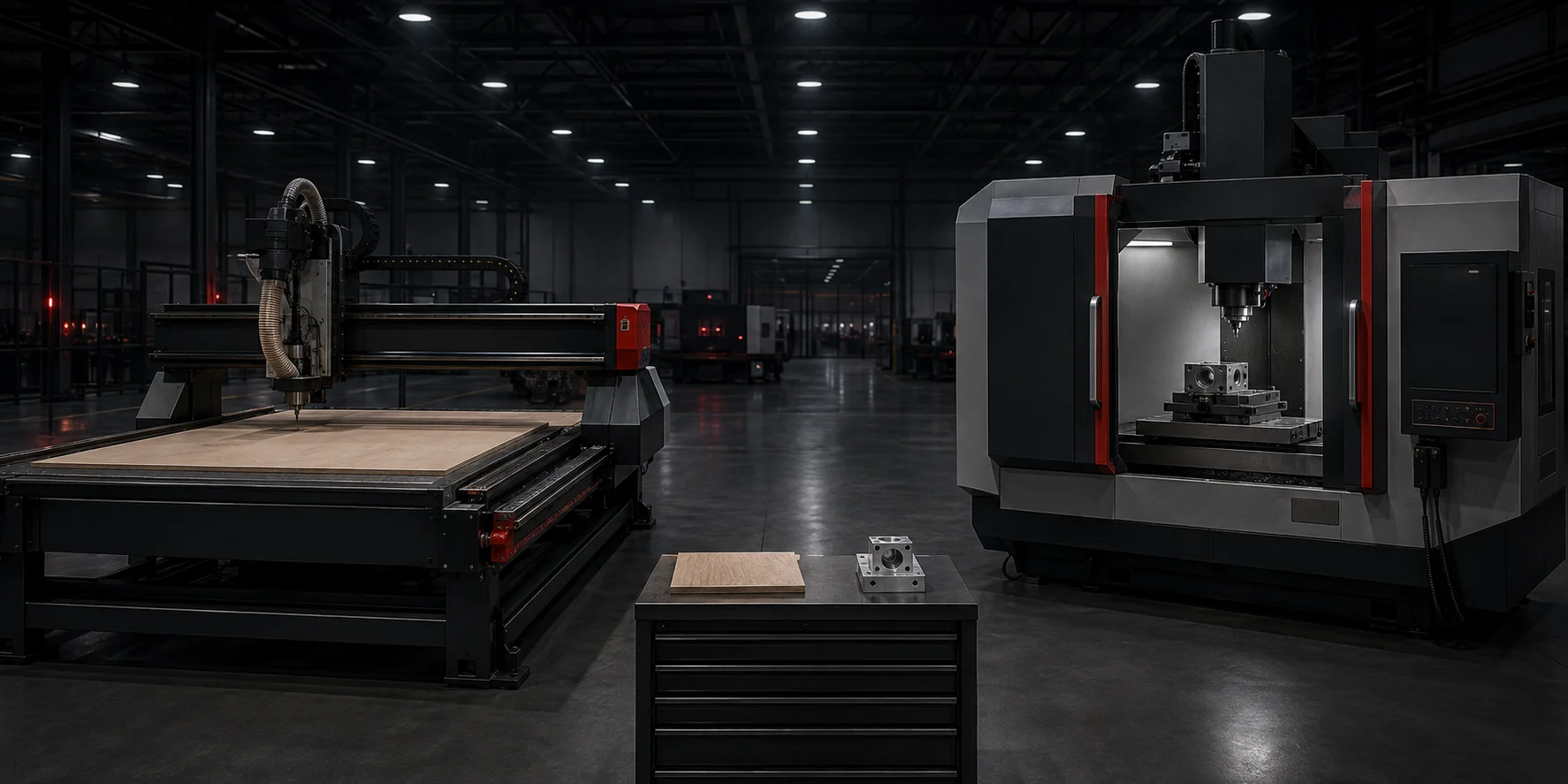
CNC routers and CNC machining centres are both computer-controlled subtractive manufacturing systems. Both move a cutting tool to defined coordinates; however, they serve different purposes in terms of frame construction, spindle character, axis layout, target materials and accuracy expectations.
To choose the right system you should look not only at “which machine is more powerful?” but at the material, geometry, tolerance and cycle time of the part to be produced.
What production is a CNC router designed for?
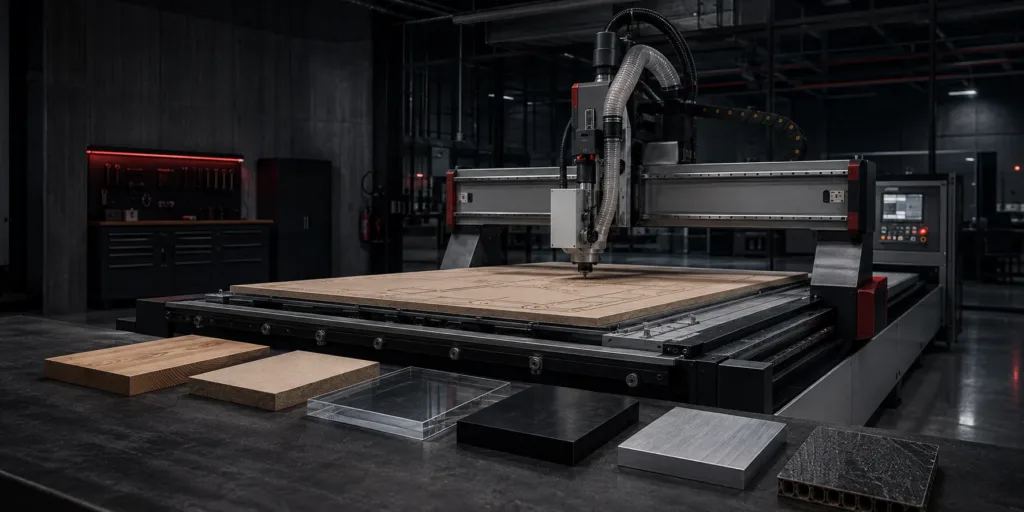
CNC routers are mostly used to process large sheet materials with high-speed cutting tools. A large working area, vacuum table, high axis speed and easy loading are their notable features. They work efficiently on wood, MDF, plastics, acrylic, composites and, under suitable conditions, aluminium.
Furniture panels, signage products, composite façade parts, mould patterns and large-surface prototypes are typical applications.
What production is a CNC machining centre designed for?
CNC machining centres are designed to perform drilling, milling, tapping, pocketing and precision surface machining on metal parts. A rigid frame, controlled torque, a tool magazine, a coolant system and chip management are among their core features.
Machine components, mould elements, automotive parts, fasteners and precision fixtures are common applications for these systems.
Key differences
| Criterion | CNC router | CNC machining centre |
|---|---|---|
| Primary materials | Wood, plastics, composites, light metals | Steel, stainless, aluminium and engineering metals |
| Frame character | Focused on large area and fast movement | Focused on high rigidity and cutting force |
| Spindle | Usually high speed | High torque capacity alongside speed |
| Workholding | Vacuum table, clamps or dedicated fixtures | T-slots, vices, pallets or precision fixtures |
| Chips and cooling | Dust extraction or application-specific removal | Flood coolant and chip conveyor |
| Typical part | Large, flat or sheet-based | Three-dimensional, precision metal parts |
Rigidity and cutting force
High cutting forces arise on hard-to-machine materials such as steel. The heavy frame, guides and drive system of a machining centre are designed to control these forces. A CNC router, by contrast, mostly focuses on moving quickly over a large area at lower cutting forces.
This difference does not mean a router is imprecise. With suitable material and correct tooling it can deliver high repeatability. But when heavy material removal and very tight metal tolerances are involved, a machining centre offers a better foundation.
Spindle speed and torque
Router spindles generally run small-diameter tools at high speed. This structure is an advantage when processing wood, plastics and aluminium sheet. A machining centre spindle, on the other hand, focuses on providing sufficient torque at low and medium speeds with tools of various diameters.
What matters is not only that the tool turns, but that it holds its speed under load. The workpiece material and the amount of material to be removed determine the torque required.
Tool changing and process variety
Both machine types can be equipped with an automatic tool changer. On a CNC router this allows different cutting, grooving and drilling tools to be used one after another. On a machining centre the tool magazine is one of the essentials for completing multi-operation parts in a single setup.
Equipment such as tool measurement probes, part zeroing probes and broken-tool detection can improve process reliability.
Accuracy and surface quality
Accuracy does not depend on control system resolution alone. Frame rigidity, thermal stability, guides, ball screws or rack-and-pinion systems, tool runout, fixturing and ambient temperature all play a part.
Contour cutting a large composite panel and surface machining a precision steel mould element do not have the same requirements. Rather than a single accuracy figure in a catalogue, the tolerance and surface expectation on the actual part should be assessed.
Which should you choose?
- If large sheets, high speed and material variety are the priority, a CNC router can be considered.
- If steel parts, high cutting forces and tight tolerances are the priority, a CNC machining centre is more suitable.
- If aluminium is to be machined, part geometry, material removal volume and tolerance level decide the choice.
- For both systems, the result of machining a real sample is worth more than a theoretical comparison.
Pre-investment checklist
Prepare the technical drawings of the parts, the material list, annual quantities, critical tolerances and the target cycle time. Include tooling, fixturing, CAM software, cooling, chip extraction and operator training costs in the investment calculation. Assess the machine not only against current work but also against the product variety you can foresee.
In summary: A CNC router and a CNC machining centre are not direct alternatives to one another. Each was developed for different materials and production priorities. The right choice comes from matching the technical needs of your part family to the mechanical character of the machine.