Fiber laser and CO₂ laser are the two fundamental laser technologies used in industrial cutting and marking applications. Both process material with concentrated beam energy; however, the way the beam is produced, its wavelength, the materials that can be processed, the maintenance structure and the operating character differ.
For this reason there is no single answer to the question “which is better?”. The right choice should be made according to the material to be processed, the thickness range, the production volume, the quality expectation and the total cost of the investment.
What is a fiber laser?
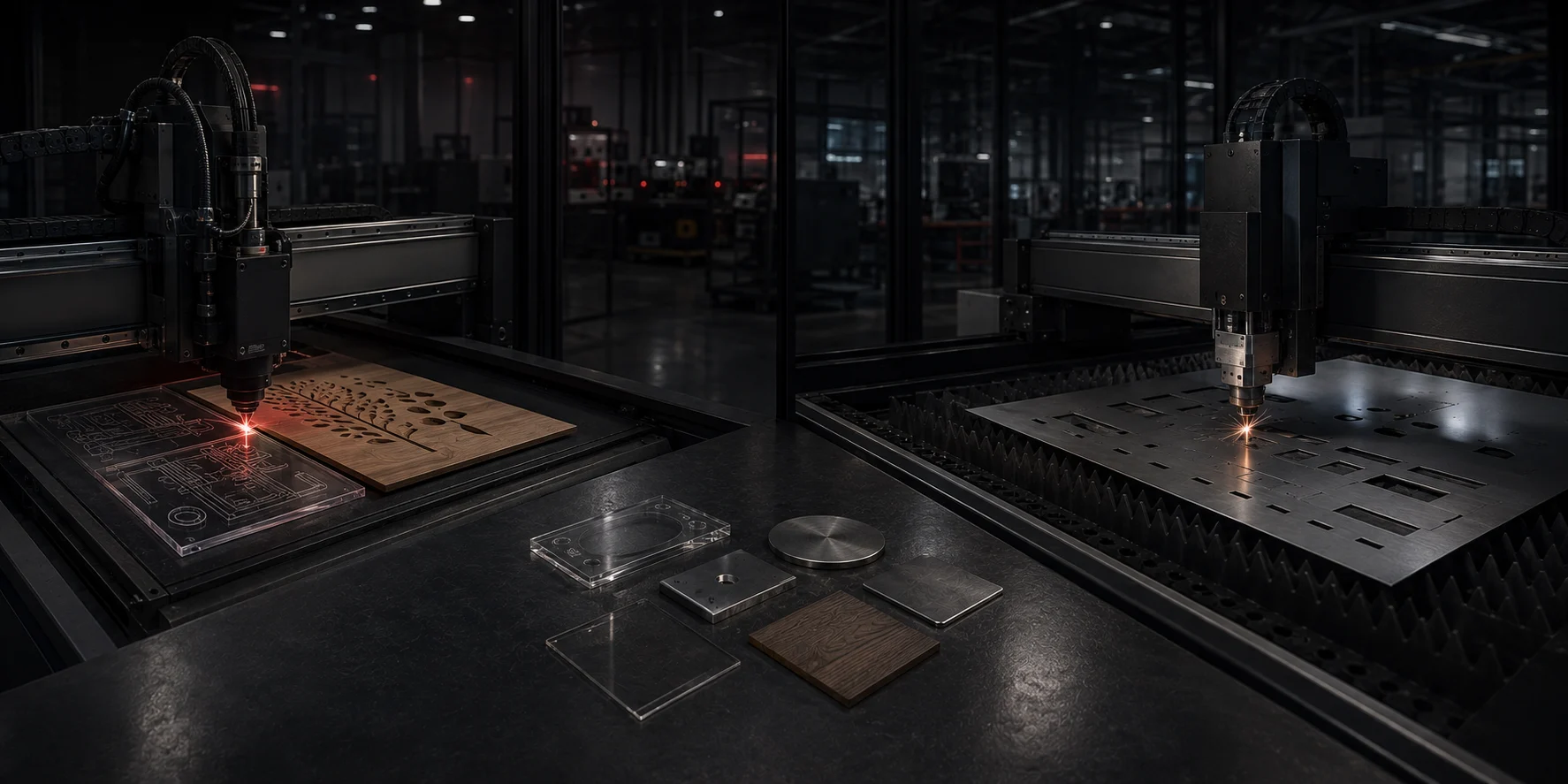
In a fiber laser the beam is generated in a solid-state laser source and delivered to the cutting head through a fiber optic line. The system can carry energy to the cutting zone without needing a moving mirror arrangement. Thanks to a wavelength that is well absorbed by metal, it offers high energy efficiency and speed, particularly in sheet metal cutting.
Carbon steel, stainless steel, galvanised sheet, aluminium, brass and copper are the main application areas for fiber lasers. The thickness that can be cut and the speed achieved depend on the laser power, the material type, the assist gas and the targeted edge quality.
What is a CO₂ laser?
A CO₂ laser produces its beam by exciting a gas mixture based on carbon dioxide. The beam is mostly directed to the cutting head using mirrors. Its longer wavelength is effectively absorbed by many non-metal materials.
CO₂ lasers are widely used for cutting or engraving acrylic, wood, MDF, fabric, leather, paper and certain plastics. Although metal processing is possible on suitable systems, fiber lasers are more advantageous in most sheet metal production scenarios.
Fiber laser and CO₂ laser compared
| Criterion | Fiber laser | CO₂ laser |
|---|---|---|
| Primary use | Metal cutting and marking | Non-metal cutting and engraving |
| Common materials | Steel, stainless, aluminium, brass, copper | Acrylic, wood, fabric, leather, paper |
| Beam delivery | Fiber optic line | Mirrors and optical elements |
| Maintenance | Generally less need for optical alignment | Mirror cleaning and optical alignment more critical |
| Energy efficiency | Usually higher in metal processing | Varies with application and source |
| Engraving capability | Strong on metals | Broad range of use on non-metals |
Why is material selection decisive?
How well the laser beam is absorbed by the material directly affects the efficiency of the process. The fiber laser wavelength is strongly absorbed by metals, while the CO₂ wavelength is more suitable for many organic and transparent non-metal materials. Cutting transparent acrylic with a clean, polished edge, for example, is one of the applications where CO₂ lasers stand out.
On the other hand, not every plastic is suitable for laser processing. Materials of unknown composition, or those that may release hazardous gases during cutting, should be checked against manufacturer information and occupational safety requirements before use.
How do cutting speed and quality change?
On thin sheet metal a fiber laser can offer strong production speed thanks to high beam absorption and fast axis movements. As thickness increases, laser power, gas selection and the desired edge quality become more important. A CO₂ laser, meanwhile, provides flexibility by performing cutting and engraving within the same production flow on non-metal materials.
Judging cutting speed on its own is misleading. Part nesting, piercing times, corner behaviour, loading and unloading, and post-cut cleaning determine the total production time.
Differences in maintenance and operation
In fiber laser systems, carrying the beam through a fiber line removes the mirror chain found in traditional CO₂ laser systems. This can reduce optical alignment and mirror maintenance. Even so, the cutting head protective glass, nozzle, filter, cooling system and gas line require regular checks in both technologies.
In CO₂ lasers the resonator structure, mirrors, lenses, airflow and cooling system are important parts of the maintenance plan. Maintenance needs depend not only on the technology but also on the cleanliness of the working environment and daily running time.
Which technology suits which business?
- If the main production is sheet metal cutting, a fiber laser is usually the first technology to consider.
- For production dominated by acrylic, wood, fabric or leather, a CO₂ laser may be more suitable.
- If both cutting and engraving will be done, the variety of materials and the ratio of jobs should be examined together.
- The investment decision should be based not only on the purchase price but on energy, consumables, maintenance and production capacity.
What information should be prepared before deciding?
Listing the materials the business processes, the thickness ranges, average part dimensions and monthly production time is the right starting point. Testing sample parts under real production conditions makes cutting time and edge quality visible. Installation area, electrical infrastructure, gas requirements, fume extraction and operator training should also be included in the investment plan.
In summary: Fiber lasers stand out for speed and efficiency in metal production, while CO₂ lasers stand out for the variety of non-metal materials and engraving capability. The right technology is the one that answers both what the business does today and the production structure it targets for the future.