Automation in production is the execution of activities such as material movement, processing, measurement, quality control and data collection according to defined rules using sensors, control systems, software and mechanical equipment. The aim is not only to reduce human labour but to make the process more stable, measurable and repeatable.
Successful automation does not mean simply buying a robot or a fast machine. Bottlenecks must be analysed, a standard workflow established and people’s role in the new system correctly defined.
At what levels can automation be applied?
Single-operation automation
This is where a specific task is carried out by the machine, such as part checking with a sensor, automatic tool changing or automatic lubrication. It usually starts with limited investment and can deliver quick gains.
Machine-cell automation
Automatic loading and unloading, pallet changing, sheet storage, part sorting or robotic feeding fall into this level. The aim is to reduce the machine’s idle waiting time and ease the operator’s repetitive work.
Cell and line automation
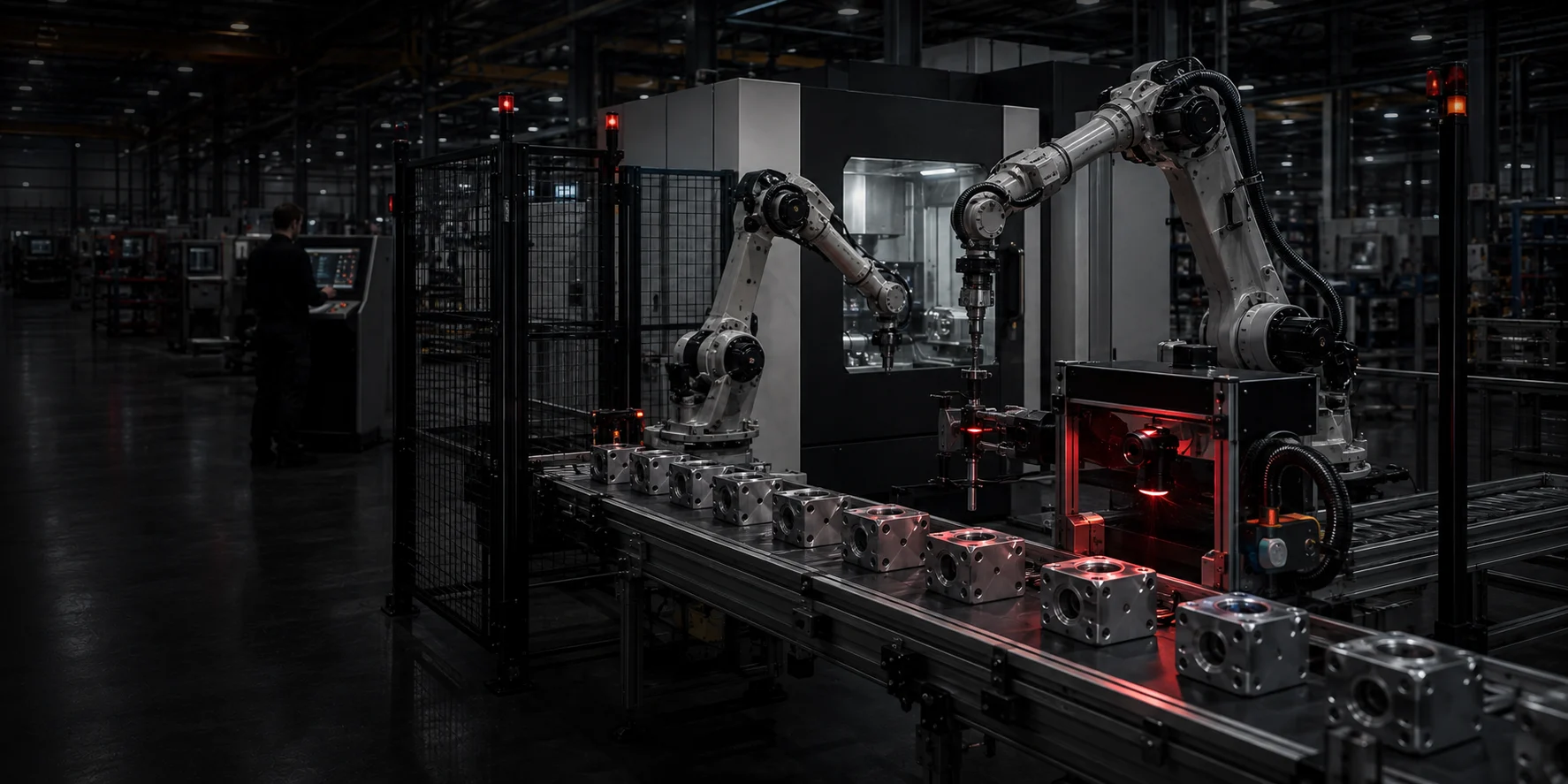
This is where several machines, robots, conveyors and quality stations work in a shared production flow. How the part moves between stations and at which point a fault stops the line are defined in advance.
Digital production management
This is the monitoring of machine status, cycle time, production quantity, faults and quality data in central systems. This layer makes the performance of physical automation measurable.
Core benefits of automation
Repeatable production
Carrying out standard tasks in the same order and with the same parameters can reduce operator-dependent variability. It particularly helps maintain part quality across shifts in high-volume production.
Higher availability
When the time the machine spends waiting for material or an operator is reduced, total production can increase. The success of automation should be measured not by the machine’s instantaneous speed but by how long it stays in production across the shift.
Occupational safety and ergonomics
When handling heavy, hot, sharp or repetitive parts is automated, the physical risk to employees can be reduced. That said, robots and automated lines create new safety risks, so area guarding, safety sensors and procedures must be designed correctly.
Traceability
Automatic collection of production data makes it easier to track which part was produced when, with which parameters and with what result. When a problem arises, root cause analysis can be carried out faster.
Does automation always mean faster production?
No. A poorly designed automation system can feed an existing bottleneck faster, or allow a small fault to stop the whole line. If product variety is very high and quantities very low, a rigid automation structure requiring frequent changeover can be inefficient.
Before an automation decision, cycle time, changeover frequency, fault impact, maintenance competence and expected order volume should be analysed.
Find the bottleneck first
The capacity of a production line is usually limited by its slowest or most variable process. If automation is invested in a station that is not the bottleneck, work in progress may increase while total output stays the same.
- Map the current production flow step by step.
- Measure cycle, waiting, transport and changeover times.
- Identify the points where quality losses and downtime concentrate.
- Choose the small automation step that will deliver the greatest impact.
- Do not roll it out across the whole line before measuring the result of the pilot.
Why does flexibility matter?
In businesses with product variety, fixtures, programs and grippers must be able to change quickly. Modular cells and reprogrammable robots can make it easier to adapt to future product changes.
The price of flexibility is sometimes a higher initial investment or more complex programming. This cost should be weighed against product life cycle and expected variation.
Where do people fit into automation?
Automation transforms the operator’s role rather than removing it. Repetitive physical tasks can give way to process monitoring, program management, quality control, maintenance and problem solving. A training budget is therefore an inseparable part of an automation project.
How the system will be stopped in an abnormal situation, how a fault will be cleared safely and who has the authority to restart must be clearly defined.
Which indicators measure success?
- Conforming part quantity and production rate
- Machine availability
- Cycle and changeover time
- Scrap and rework rate
- Output per operator
- Energy and consumable consumption
- Unplanned downtime
- Safety incidents and ergonomic indicators
A phased approach to automation
The safest route is to start with a measurable problem and grow the system in stages. A limited application such as data collection or automatic workholding can be commissioned first. Once the result is validated, material feeding, robotic handling and line integration can be added.
In summary: The value of automation is measured not by how much technology is used, but by how much stable production it delivers safely. Businesses that analyse the process, include people in the system and track results with data gain more sustainable benefit from automation.