The purpose of maintenance on production machines is not only to get the system running again when a fault occurs. Planned maintenance aims to preserve machine availability and production quality by detecting wear, contamination, loosening and drifting settings before they turn into failures.
A short, planned maintenance stop is far more manageable than a breakdown with no known end time. Regular maintenance also helps plan spare part requirements in advance and protect the production schedule.
Why is unplanned downtime expensive?
When a machine stops, it is not only the production during that time that is lost. Operators wait, subsequent operations run out of material, deliveries can be delayed and urgent outsourced production may be needed. If the fault damages a critical component, the repair cost also rises.
When assessing downtime cost, lost contribution, continuing labour, overtime, logistics changes and delay risk should be considered together.
What does planned maintenance cover?
Cleaning and the working environment
Dust, metal particles, fumes and oil residue can affect sensors, fans, filters and moving parts. The area around the electrical cabinet, air inlets, guides and the working area should be cleaned at defined intervals. The cleaning method should be chosen so as not to damage the equipment.
Lubrication system
Guides, ball screws, rack and pinion and other motion elements require the right type and sufficient quantity of lubrication. Having an automatic lubrication system does not remove the need for checks; reservoir level, lines and distribution points should be monitored.
Optical and cutting components
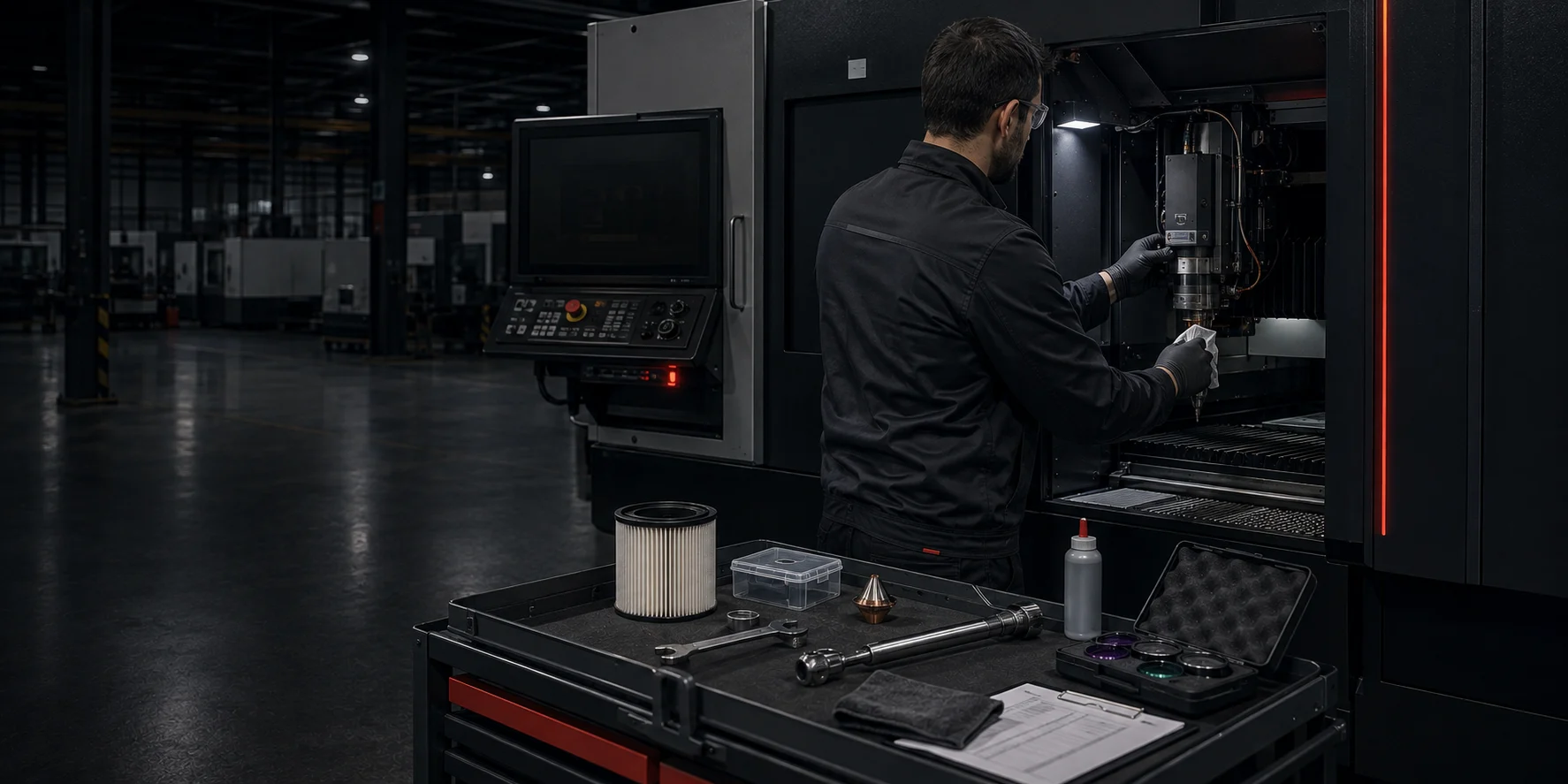
On laser systems the protective glass, nozzle and cutting head should be checked regularly. Dirty or damaged optical elements can reduce cut quality and lead to greater damage. Nozzle centring and height sensing checks are also part of the maintenance plan.
Spindle and tool holders
On CNC systems, spindle noise, temperature, vibration and tool runout should be monitored. Dirt or wear in collets and tool holders affects surface quality. Tools should be replaced according to their defined life or measured wear.
Cooling, air and gas systems
Coolant level, filters, hoses, connections and temperature values should be checked regularly. Leaks in compressed air and gas lines both increase cost and disturb process stability.
Electrical and safety systems
Emergency stop buttons, door sensors, light curtains, earthing and safety circuits should be tested on a plan. Loose connections or signs of overheating inside the electrical cabinet should only be checked by authorised personnel.
Daily, weekly and periodic maintenance
| Interval | Example checks |
|---|---|
| Every shift / daily | Visual check, cleaning, consumable status, fluid and oil levels, unusual noise |
| Weekly | Filters, connections, working area, nozzle or tool holder, extraction system |
| Monthly | Lubrication distribution, mechanical connections, air and gas leaks, safety functions |
| Periodic | Axis accuracy, spindle or cutting head, electrical cabinet, cooling system and manufacturer checks |
Actual maintenance intervals should be set according to machine type, running time, environment and manufacturer instructions. A general list does not replace the machine’s own maintenance manual.
Why do maintenance records matter?
At each maintenance the date, running hours, work performed, parts replaced, measurement results and the person responsible should be recorded. Trends such as the same component failing frequently, or a temperature value rising over time, only become visible through regular records.
Records also help determine spare part stock and planned service times.
The operator’s role
The operator is the person who observes the machine every day and the first to notice unusual noise, vibration, smell or a change in quality. Operator checklists should therefore be short, clear and practical.
Operator maintenance should be kept separate from authorised technical service work. No unauthorised intervention should be made on electrical systems, laser sources, pressurised systems or safety circuits.
How to plan spare parts
Consumables, critical spares and long-lead components can be classified separately. Frequently used parts such as nozzles, filters or cutting tools should be stocked according to consumption rate. For critical parts that could stop production entirely, lead time and an alternative support plan should be assessed.
How is maintenance success measured?
- Unplanned downtime duration and frequency
- Mean time between failures
- Mean time to repair
- Compliance rate with the maintenance plan
- Scrap and rework rate
- Change in consumable usage
In summary: Planned maintenance is not an obligation that stops production; it is a production activity that prevents larger and less predictable stoppages. When a manual-based maintenance plan, trained operators, regular records and the right spare part stock are applied together, machine reliability and process quality both improve.